Walk Like Dogs: Learning Steerable Imitation Controllers for Legged Robots from Unlabeled Motion Data
ArXiv
Abstract
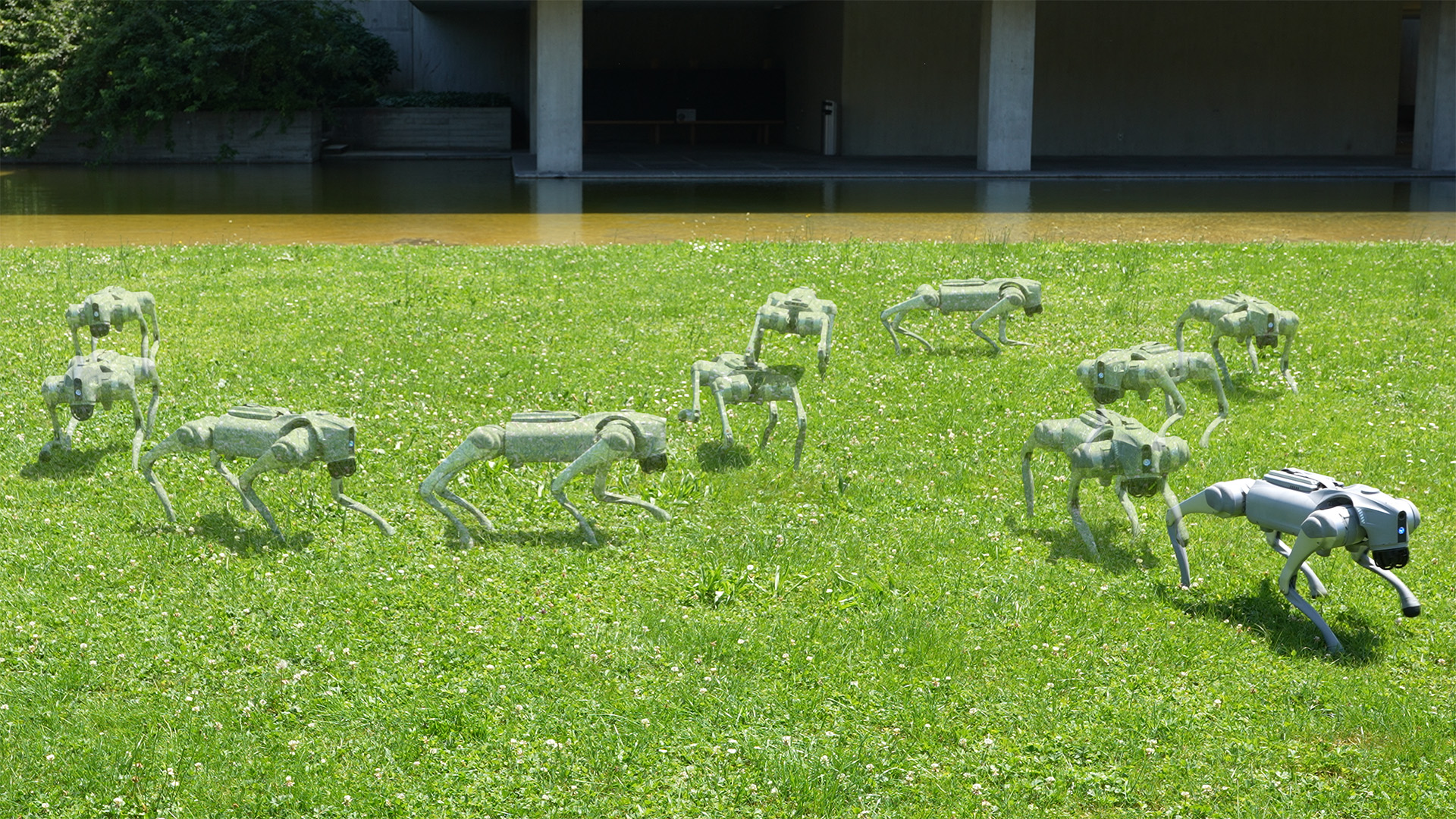
We present an imitation learning framework that extracts distinctive legged locomotion behaviors and transitions between them from unlabeled real-world motion data. By automatically discovering behavioral modes and mapping user steering commands to them, the framework enables user-steerable and stylistically consistent motion imitation. Our approach first bridges the morphological and physical gap between the motion source and the robot by transforming raw data into a physically consistent, robot-compatible dataset using a kino-dynamic motion retargeting strategy. This data is used to train a steerable motion synthesis module that generates stylistic, multi-modal kinematic targets from high-level user commands. These targets serve as a reference for a reinforcement learning controller, which reliably executes them on the robot hardware. In our experiments, a controller trained on dog motion data demonstrated distinctive quadrupedal gait patterns and emergent gait transitions in response to varying velocity commands. These behaviors were achieved without manual labeling, predefined mode counts, or explicit switching rules, maintaining the stylistic coherence of the data.
Open access: [ArXiv]
Supplementary Video
Demos
Bibtex
@misc{kang2026walklikedogs,
      title={Walk Like Dogs: Learning Steerable Imitation Controllers for Legged Robots from Unlabeled Motion Data},
      author={Dongho Kang and Jin Cheng and Fatemeh Zargarbashi and Taerim Yoon and Sungjoon Choi and Stelian Coros},
      year={2026},
      eprint={2507.00677},
      archivePrefix={arXiv},
      primaryClass={cs.RO},
      url={https://arxiv.org/abs/2507.00677},
}
Acknowledgment
This work has received funding from the European Research Council (ERC) under the European Union’s Horizon 2020 research and innovation programme (grant agreement No. 866480.)